


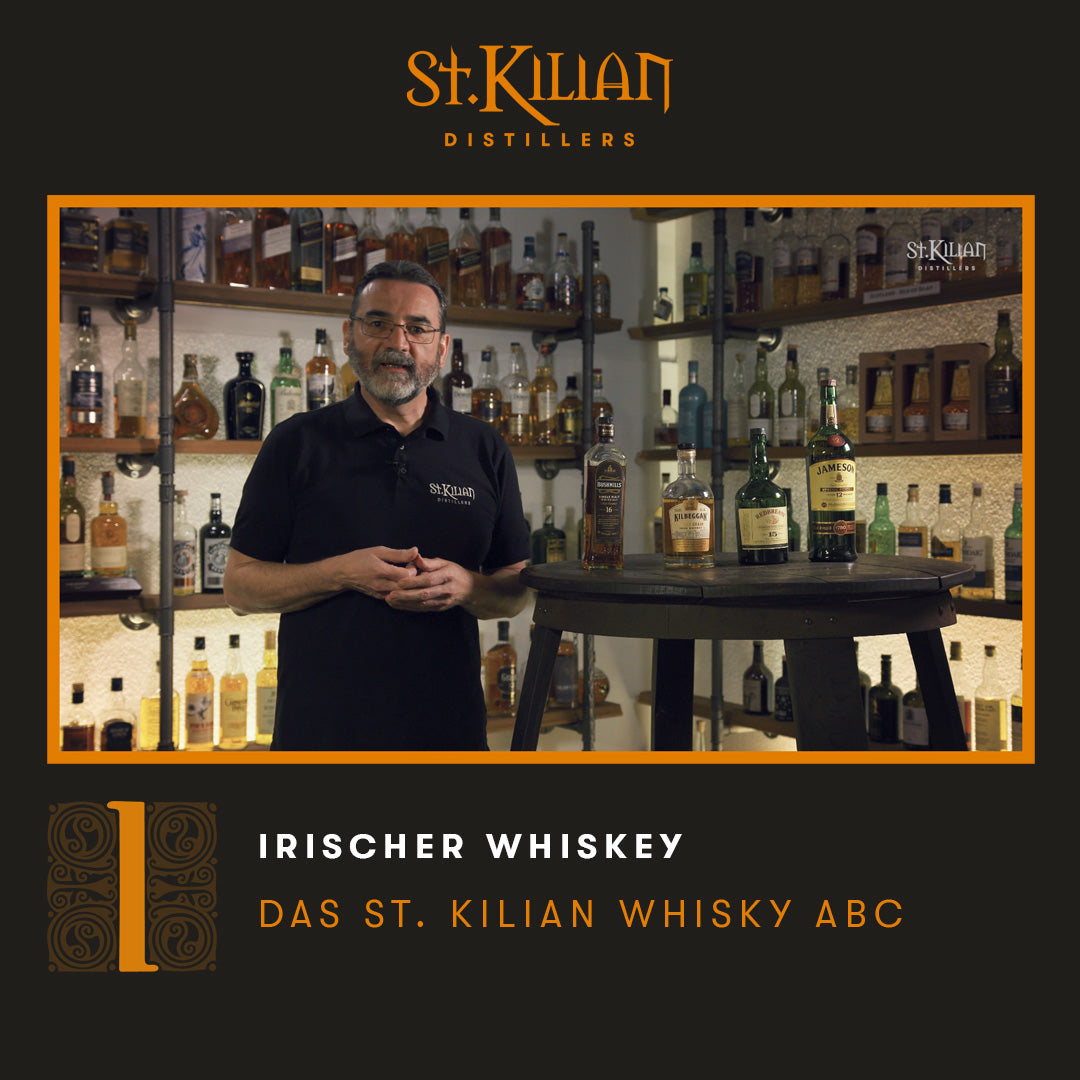

What is Irish Whiskey?
Irish Whiskey is a spirit produced on the island of Ireland, including Northern Ireland. According to the regulations of EU Regulation 2019/787 of the European Parliament and of the Council, it is distilled from a mash of malted cereals, which may contain whole grains of other cereals. In addition, the following conditions must be met:
The mash was
- saccharified by the diastase of the malt contained therein, with or without other natural enzymes;
- fermented by the action of yeast;
- distilled to less than 94.8% alcohol by volume so that the distillate has an aroma and taste derived from the materials used.
The final distillate must be aged for at least three years in wooden casks, e.g., made of oak, with a capacity not exceeding 700 liters. Only water and plain caramel coloring may be added to the aged whiskey.
Who ensures that these regulations are complied with?
On the Emerald Isle, the Irish Whiskey Association (IWA) carefully ensures that only products manufactured and labeled according to the product specification for Irish Whiskey may be marketed and sold as Irish Whiskey. The IWA plays a similarly important role to the Scotch Whisky Association (SWA) in Scotland, the regulatory body for Scotch Whisky there.
Which whiskey styles are represented in Ireland?
There are various Irish styles such as Irish Malt Whiskey, Irish Grain Whiskey, and Irish Blended Whiskey, which follow the corresponding definitions of Scottish bottlings. A unique style found exclusively in Ireland is Irish Pot Still Whiskey. The vast majority of Irish whiskeys are triple distilled, mild, and not smoky. They are made with grain that has been dried with hot air and not kilned over peat smoke.
What is an Irish Single Malt Whiskey?
This is a malt whiskey made exclusively from malted barley and originating from a single Irish distillery. As in Scotland, Irish Malt Whiskey is batch distilled in traditional pot stills, but usually triple distilled. A typical example of a mild, triple-distilled Irish single malt whiskey is Bushmills 16 Year Old. In contrast, a Connemara Single Malt Irish Whiskey is only double distilled in pot stills and made from malted barley that has previously been kilned over peat smoke.
What is an Irish Grain Whiskey?
An Irish Grain Whiskey is made from a variety of grains, including corn, wheat, barley, oats, and rye. Often, the choice of grain is determined by the current price, with the cheapest option chosen for whiskey production. A small amount of about 5 to 10 percent malted barley is added to the grain, as it contains the necessary enzymes to convert the starch in the grains into sugar during mashing, which can then be fermented. Irish Grain Whiskey is also triple distilled in large columns, known as column stills or Coffey stills. A well-known representative of a Single Irish Grain Whiskey is that produced by the Kilbeggan distillery.
What is an Irish Pot Still Whiskey?
Irish Pot Still Whiskey is a unique style found exclusively in Ireland. It is distilled from a mash composed of a mixture of at least 30 percent malted and unmalted barley each, and a maximum of 5 percent other unmalted grains, such as oats and rye. The saccharification is carried out by the grain's own enzymes, either alone or together with added natural enzymes. The fermented mash is distilled in pot stills, with triple distillation being traditional, although double distillation is also possible. If this type of whiskey comes from only one distillery, it is called Irish Single Pot Still Whiskey, such as Redbreast 15 Year Old.
What makes Irish Pot Still Whiskey so special?
At the beginning of the 19th century, when taxes on malt were increased, Irish distilleries simply added the cheaper, unmalted barley to the mash of malted barley to save on taxes. This did not harm the whiskey. After the resulting distillate was aged in wooden casks, a rich, oily whiskey with an increased proportion of fatty acids was created. The addition of oats was intended to give the whiskey an additional spicy note. In October 2021, the IWA proposed changes to the product specification for Irish whiskey. These include an expansion of the definition of Pot Still Irish Whiskey, allowing the use of up to 30 percent of other grains, particularly oats, wheat, or rye. This would more accurately reflect the traditional grain recipes (mash bills) of Irish Pot Still Whiskey.
What is an Irish Blended Whiskey?
This Irish whiskey category, like in Scotland, is made from a blend of various aged malt and grain distillates. A very popular Irish Blended Whiskey is Jameson. This mild, triple-distilled whiskey is the best-selling Irish whiskey in the world.
How many Irish distilleries are there?
In the mid-19th century, there were 88 licensed distilleries on the island of Ireland. However, the separation from Great Britain and Prohibition in America at the beginning of the 20th century led to a drastic decline in demand for Irish whiskey and a distillery demise from which the industry did not recover for a long time. Until the mid-1980s, there were only two Irish whiskey distilleries. This number increased to eight by 2014. But then the tide began to turn. In recent years, the whiskey industry in Ireland has experienced remarkable growth. In 2016, 17 distilleries were already active, and today there are more than 40. Irish whiskey is currently considered the fastest-growing spirits category worldwide.
Does St. Kilian also have an Irish Whiskey in its range?
No, in Rüdenau we naturally cannot produce authentic Irish whiskey. Nevertheless, we like to refer to our whiskeys, which come from a distillate where the reflux condenser, i.e., the additional cooling coil in the lyne arm of our spirit still, has been switched to full power, as "Irish Style". This maximum reflux makes our spirit "multiple distilled" and ensures a smooth new make. Examples of this are the Signature Edition ELEVEN and the single cask bottling "Irish Style", which were released in autumn 2022 and spring 2024 respectively.

Leave a comment
This site is protected by hCaptcha and the hCaptcha Privacy Policy and Terms of Service apply.