


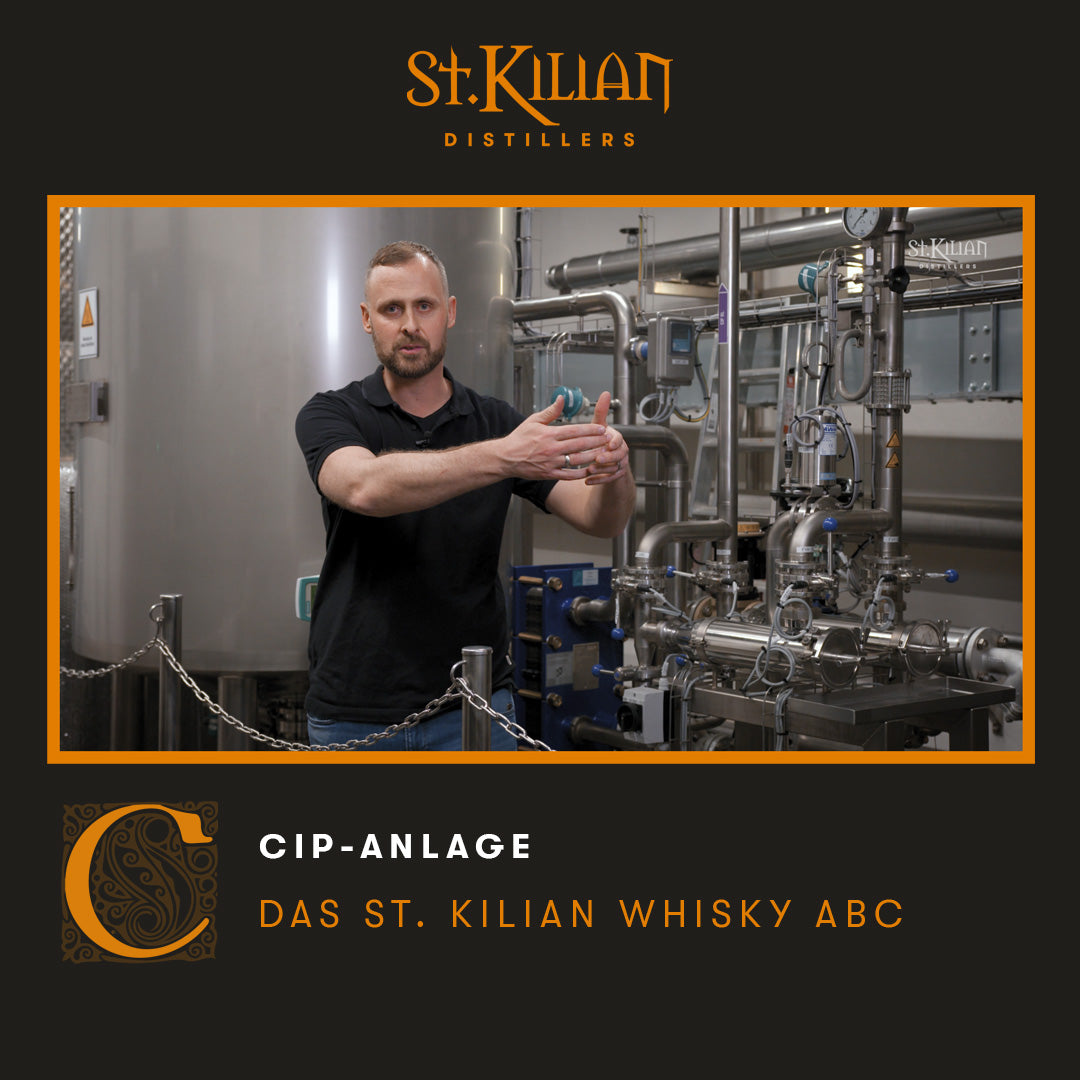

What does the abbreviation CIP stand for?
CIP stands for Cleaning In Place. It refers to a special cleaning system.
What is a CIP system needed for?
The CIP system is used to clean the entire production facility at St. Kilian Distillers. Although it is not a direct part of the actual production process, it is still a crucial element of our overall production facility. Such a cleaning system complies with hygiene standards in the food industry and ensures the cleanliness of all process lines, vessels, tanks, and other components. Furthermore, it significantly contributes to maintaining productivity by ensuring a smooth and hygienic operation of all processes.
What all gets cleaned?
The CIP system cleans all pipelines, heat exchangers, tanks, filters, the mash tun, and ultimately our two pot stills, including the condensers and subcoolers. It removes deposits and impurities, thereby preventing blockages that can occur, for example, in the fine-mesh heat exchanger plates. In this way, the CIP system ensures hygienically perfect conditions in the production plant, preventing microbial processes from negatively affecting, for example, our Distillers Beer (= Wash).
What does the CIP system at St. Kilian look like?
The CIP system comprises a large stainless steel storage tank, an insulated tank for the cleaning solution, a heat exchanger, and a multitude of technical components such as fittings, valves, filters, and pumps.
What does the cleaning solution consist of?
The cleaning solution used by St. Kilian consists of a two percent caustic soda solution.
How does the CIP system work?
The cleaning solution is heated to approximately 80°C and then pumped through the various pipelines to each vessel and tank. All organic residues from the entire production facility are removed by the hot caustic soda solution. This cleaning process is cyclical, causing the caustic soda solution to return to the system's storage tank.
What happens to the organic residues?
The organic residues detached by the caustic soda solution are removed by a filtration system with two built-in filters as they flow back to the storage tank. However, a small portion of the residues remains dissolved in the caustic soda solution.
Can the caustic soda solution be reused?
Yes, due to the closed-loop principle, the cleaning solution can be used multiple times. After being heated to a temperature of 80°C, its concentration can be brought back to two percent if necessary by a targeted addition of lye. It is only disposed of when it becomes too heavily contaminated.
How long does the cleaning process with the CIP system take?
Thanks to the circulating system, the entire process plant is cleaned of all organic residues with the hot caustic soda solution within 20 to 30 minutes.
What factors need to be considered during cleaning?
To achieve an optimal cleaning effect, we at St. Kilian considered the following factors when planning the CIP system: time, concentration, temperature, and mechanics. Due to the circulation system, the cleaning time can be flexibly adjusted, while the temperature can be regulated via the steam heat exchanger. To check the lye concentration, conductivity is measured to adjust it, if necessary, by adding lye and maintaining it at two percent. The mechanics can be controlled via the pump speed of the CIP supply pump and appropriately designed spray heads in the tanks and pot stills.
Is every CIP system equipped in this way?
No. Our CIP system is a customized, one-off production, tailored down to the smallest detail to our needs. Every operation has different requirements that must be considered when planning a cleaning system to meet the high hygiene standards in the food industry.



Leave a comment
This site is protected by hCaptcha and the hCaptcha Privacy Policy and Terms of Service apply.