


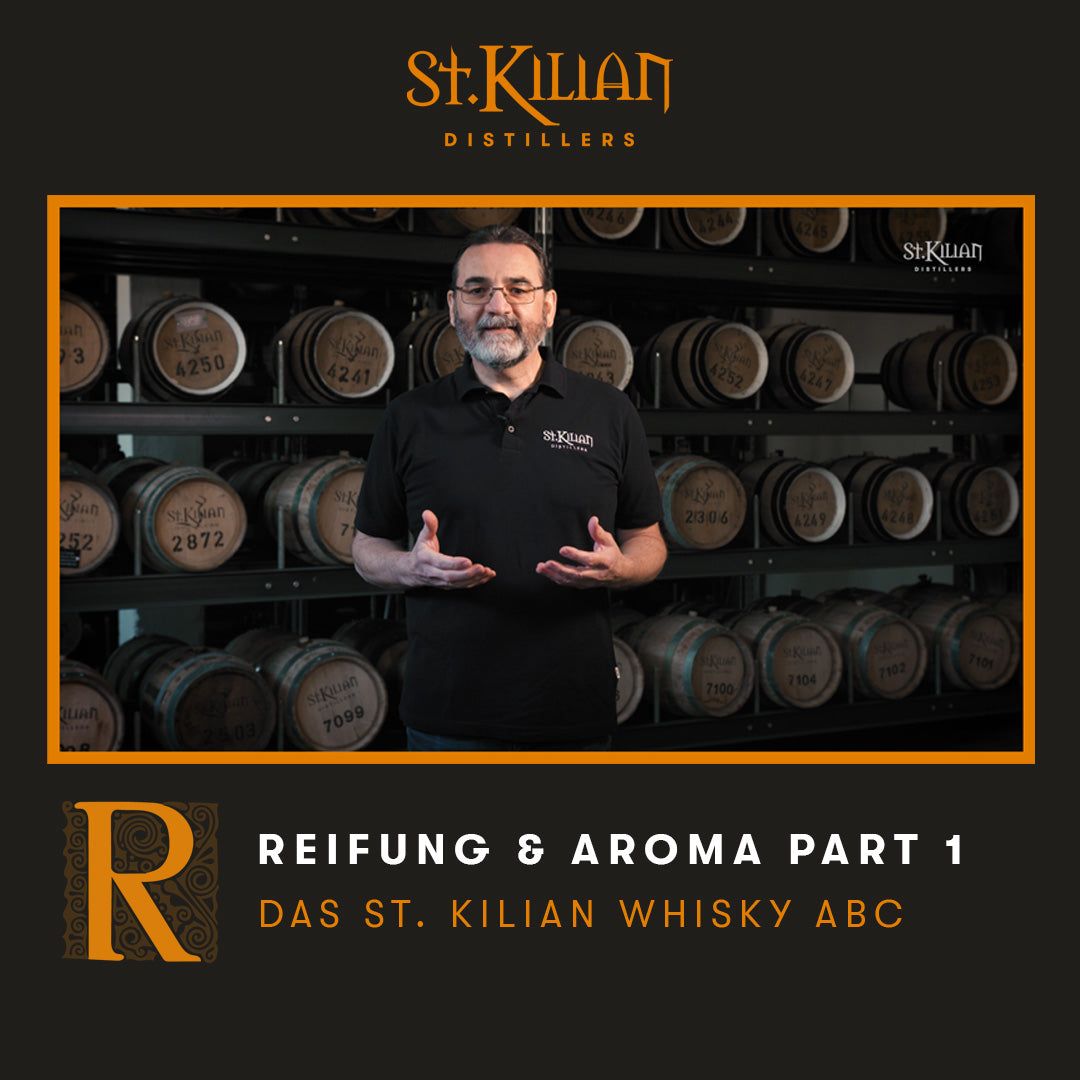

Why does whisky mature in casks?
For a whisky to officially be called whisky, the fresh distillate – also known as New Make or White Dog – must be filled into a wooden cask. Depending on the country and its regulations, it usually has to mature in it for at least two or three years. For example, in Scotland, a minimum maturation period of three years in an oak cask is prescribed. According to Spirit Drinks Regulation 2019/787 of April 17, 2019, which applies to the European Union and thus to Germany, German whisky must also adhere to a minimum maturation period of three years.
Does the maturation cask always have to be made of oak?
No. While some countries require the exclusive use of oak wood for maturation casks (see Scotland), in Germany, for example, a wide variety of woods can be used for building casks for whisky maturation, in addition to oak. However, the majority of such casks used in Germany are made of oak wood.
Does maturation in casks affect the whisky?
Oh yes, it does! During maturation in wooden casks, the colorless New Make changes its aroma and taste and takes on a color that can range from straw yellow to amber to mahogany. Leading experts estimate that approximately 60 to 80 percent of a whisky's aroma and taste come from cask maturation.
What is the most commonly used type of cask in the whisky industry?
The most commonly used casks for whisky maturation are former (ex) Bourbon casks. These are fresh oak casks that were used once for the maturation of American Bourbon Whiskey and then exported to other countries. Most of these are American Standard Barrels (ASB) with a capacity of 190 liters.
What wood are Bourbon casks made of?
Bourbon casks are made from American white oak ("Quercus alba"). The staves of this oak species are assembled into a barrel, and before filling, the inside is charred with an open flame until a thin, black layer of charcoal forms. This thermal treatment of the inside of the cask is referred to by experts as "charring."
What is the purpose of charring oak casks?
During the charring of the inner surface of the oak casks, certain substances in the oak wood are chemically altered by the heat. This creates various color and aroma compounds, which are released into the distillate during subsequent cask maturation. In addition, charring physically breaks down the structure of the oak wood, allowing the maturing spirit to penetrate the staves more easily and deeply during maturation, thereby extracting a wide variety of aromatic substances.
What wood components are these?
Oak wood, like all other plants on our planet, is composed of the three main components cellulose, hemicellulose, and lignin. Their exact percentage composition varies among different oak species. All three main components are per se odorless and tasteless and are only chemically transformed into differently aromatic degradation products by heat.
What is cellulose made of?
Cellulose is a long-chain and unbranched macromolecule composed of many thousands of linked building blocks forming long sugar strands. The individual sugar building blocks are exclusively glucose (= dextrose). Due to specific interactions, the individual sugar strands align to form a very stable fiber structure. With a share of about 40 percent of the dry weight, cellulose is the most common component of wood and thus the most widespread organic compound on Earth.
What is hemicellulose made of?
In contrast to cellulose, hemicellulose is not composed of a single sugar building block, but rather of many different sugars (e.g., glucose, xylose, galactose, arabinose, mannose) combined into a large molecule. Compared to cellulose, these sugar chains are significantly shorter, exhibit additional branching, and are partially esterified with acetic acid. In oak wood, hemicellulose accounts for approximately 20 to 30 percent of the dry weight.
How is lignin composed?
Unlike cellulose and hemicellulose, lignin is not composed of sugars. It is a complex macromolecule that – simply put – is made up of different phenols forming a three-dimensional network. Lignin accounts for approximately 20 to 30 percent of the dry weight in wood.
Which aromatic substances are formed in the wood during heat treatment?
The thermal degradation products of hemicellulose are various sugars that partially caramelize due to heat and form small ring-shaped compounds, which, in addition to color, exhibit aromas of toffee, almonds, nuts, fruits, and solvents. The more heat-stable cellulose only produces aromatic compounds at high temperatures, which impart notes of dried fruits and roasted almonds. Lignin, on the other hand, is converted by the influence of heat into a wide range of phenolic compounds that can have aromas of cloves, chocolate, smoke, and fruit.
How does the vanilla scent develop in whisky?
The chemical compound vanillin is responsible for the vanilla scent. Vanillin is naturally present in oak wood. However, a large part of the vanillin is formed by the thermal degradation of lignin. The vanilla aroma, for example, is very characteristic of American Bourbon Whiskey, which must mature in fresh, charred white oak casks.
How do the wood flavor compounds get into the whisky?
The aroma, taste, and color compounds formed from cellulose, hemicellulose, and lignin by charring the casks show different solubility behaviors. Some of these chemical compounds are exclusively water-soluble, others are only soluble in ethanol, and still others dissolve in mixtures of the two substances. When the New Make enters the cask with an average ethanol content of 63.5% vol, the ethanol-soluble aroma compounds are preferentially extracted from the staves by the distillate. During cask maturation in Germany, the alcohol content of the whisky decreases. As a result, the water content in the maturing whisky predominates over time, and the water-soluble aroma compounds in the wooden staves are now preferentially extracted. Thus, cask maturation represents a continuous dynamic process.

Leave a comment
This site is protected by hCaptcha and the hCaptcha Privacy Policy and Terms of Service apply.