


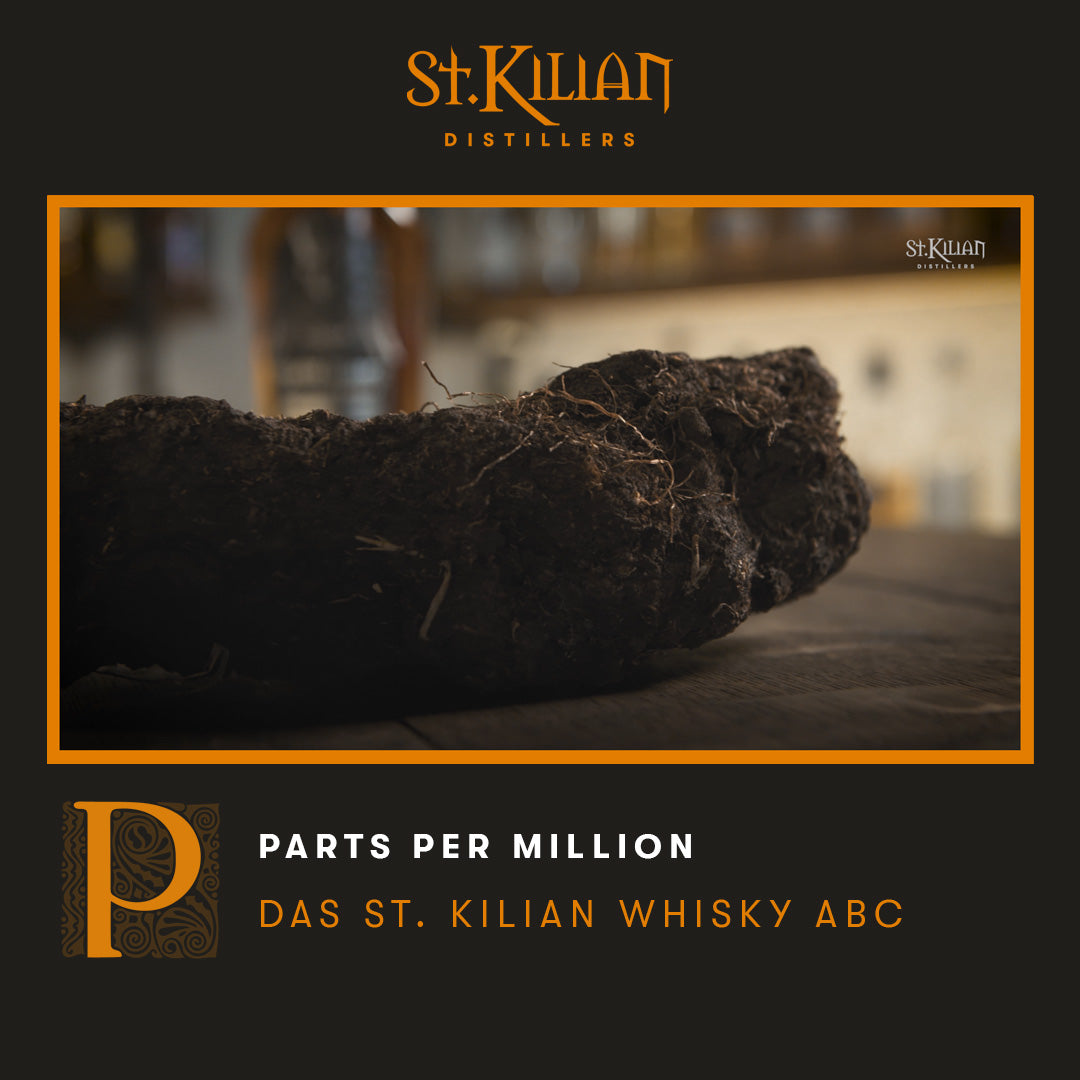

In the world of smoky and peated whiskies, connoisseurs often get excited when they hear about high numbers. The higher the number, the better. Common to these numbers is their unit, usually indicated on the label of a whisky bottle, namely PPM.
What does PPM mean?
PPM is the abbreviation for "parts per million" and literally means "parts per million."
How can one imagine PPM?
If we look at 1 gram of a compound, such as salt, then one-millionth of it, i.e., 1 microgram, which is just a few grains of salt, corresponds exactly to one PPM. Another example: Imagine a period of 11.6 days. One second in this very long period corresponds to one PPM. Or, to relate it to whisky: One drop from a 50-liter barrel filled to the brim with whisky also corresponds to one PPM. So, PPM is an almost unimaginably small unit.
What is indicated in PPM?
The proportion of phenols in barley malt, which has been kilned over smoke generated by burning peat, is expressed in PPM. In most cases, the PPM indication on a whisky bottle label refers to the amount of phenols in the peat-smoked malt. However, the amount of phenols in new make or bottled whisky can also be indicated on the label, which is usually explicitly mentioned.
What are phenols?
Phenols are organic compounds with an aromatic six-membered ring of carbon atoms, each with a hydrogen atom attached. One carbon atom of this six-membered ring replaces the hydrogen atom with an OH group, which is composed of an oxygen and a hydrogen atom. At room temperature, they present themselves either as solid or liquid compounds with a penetrating, characteristic odor, which can be described as smoky, phenolic, medicinal, brackish, or even iodine-like, depending on the phenol.
How do phenols get into barley malt?
When dried peat is burned, phenols are produced along with other chemical compounds. During kilning, these phenols are carried by the peat smoke to the moist barley malt and, due to their properties, adsorb onto the outer shell of the malt grains, the husks. Phenols also occur during the combustion of wood, for example oak or beech (cf. beech-smoked malt). Their composition and the resulting aroma sometimes differ considerably from the phenols in peat smoke.
How can the amount of phenols be determined?
There are two different analytical measurement methods to determine the phenol content in barley malt in PPM units. The first is based on a color reaction and is called the colorimetric method. The second is a significantly more precise analytical method, known as HPLC (High-Performance Liquid Chromatography).
What happens in the colorimetric method?
In this determination method, the phenols adhering to a defined quantity of peat-smoked malt are detached using a suitable solvent and mixed with a color reagent. The resulting color is then analyzed by a measuring device (colorimeter). Using a calibration curve previously created under the same conditions with a known amount of phenol, the phenol content of the peat-smoked malt sample can be deduced from the value determined by the colorimeter. However, the colorimetric method only allows for the determination of the total phenol content in peat-smoked malt.
What does HPLC achieve in phenol determination?
With an HPLC device, whose central element is a thin stainless steel column equipped with special groups inside that can interact with the various phenols, individual phenols can be identified and their individual quantities determined, compared to colorimetry. The HPLC method is therefore extremely precise and specific and represents the standard analytical method in Scotland for determining phenols in peat-smoked malt.
Which analysis method is more accurate?
Although colorimetry is easy to use and cost-effective for determining the total amount of phenols in peat-smoked malt, it often yields values that are too low due to its lack of specificity. HPLC, on the other hand, is extremely precise, provides more accurate values, and is the preferred analytical method, especially when a detailed characterization of the aroma profiles in peat-smoked malt is required.
How does the phenol content change during whisky production?
Although phenols are extremely stable, their amount decreases during the production and maturation of whisky. From milling and mashing to fermentation, double distillation, and long-term maturation in wooden casks, many phenols are lost. It is estimated that only about a third of the original phenol content in the malt is ultimately found in the matured whisky. Often it is even less.
Which method is used to determine the phenols in St. Kilian's peat-smoked malt?
Until mid-2023, our peat-smoked malt from Glenesk Maltings was analyzed using the colorimetric method, consistently showing a peating level of 54 PPM. Afterwards, the analysis method was switched to HPLC, which is the more modern and standard analytical method used in Scotland. Due to the more precise HPLC analysis method, the same peat-smoked malt we source from Scotland now showed a total phenol content of 80 PPM.



Leave a comment
This site is protected by hCaptcha and the hCaptcha Privacy Policy and Terms of Service apply.