


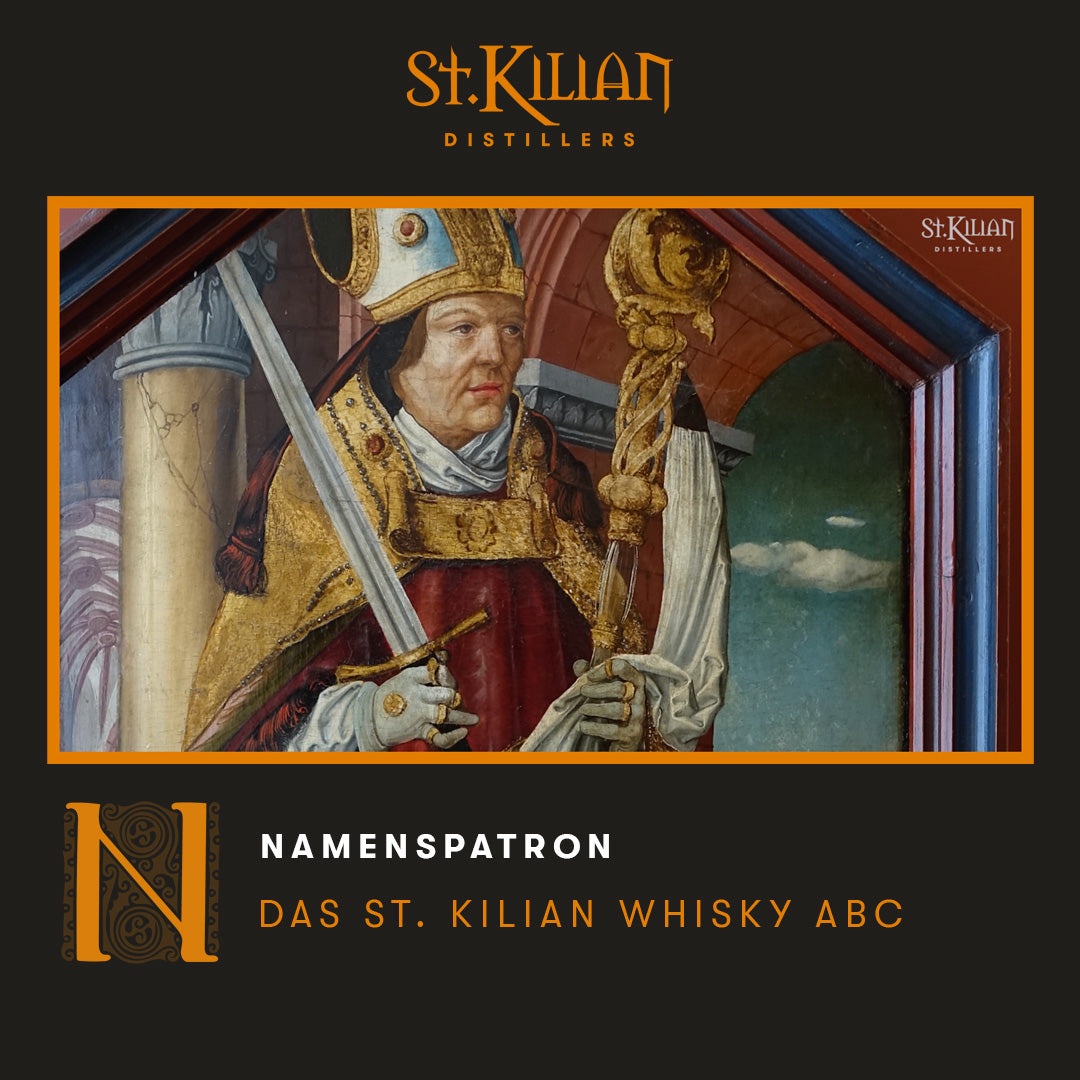

Where does the name St. Kilian Distillers come from?
In the seventh century AD, the Irish monks Kilian, Kolonat, and Totnan, along with other followers, were sent by the Pope to Franconia to Christianize the pagans there. They also came to Würzburg, today the capital of the administrative district of Lower Franconia. Even today, the three Irish monks are revered there as Apostles of Franconia. Our name "St. Kilian" thus honors the monk from Ireland and his brothers, who more than 1,000 years ago impressed and convinced people with the miraculous qualities of Aqua Vitae, the water of life.
How did the Irish monks succeed in Christianizing the pagans?
Kilian, Kolonat, and Totnan carried small copper stills with them to produce Aqua Vitae. For in the Irish monasteries at that time, they already knew how to make barley spirit. With this distillate, they were able to convince Duke Gosbert and his wife Gailana at the court in Würzburg of its healing effects on body and mind. They succeeded in converting the ruling couple to Christianity, thus gaining permission to proclaim the Christian faith in Franconia and to Christianize the pagans.
How did the Water of Life come to Rüdenau?
During their missionary journeys throughout Franconia, the monks also reached Rüdenau, the current location of our distillery. There, they mixed their drink with water from the Ottilienbrunnen, a healing spring where water gods were worshipped as early as Roman times, when the Limes was guarded. What subsequently originated at this very spot is now a legend: our St. Kilian Single Malt Whisky.
What happened to Kilian, Kolonat, and Totnan?
As was common at the time, Duke Gosbert married his brother's wife after his brother's death. However, Kilian declared that it was against Holy Scripture to be married to his brother's widow. When the widow Gailana heard this, she was furious. After Gosbert left for a war, Gailana had Kilian and his followers Kolonat and Totnan beheaded in 689 and their bodies buried behind a stable. Upon Gosbert's return, she informed her husband that the Irish monks had moved on.
How did the Irish monks become martyrs?
About 60 years later, the first Bishop of Würzburg, Burkard, commissioned the construction of a cathedral at the scene of the crime. During the necessary excavations, the desecrated bodies were discovered. According to tradition, Burkard had the remains transferred to the Marienkirche and, on July 8, 752, elevated the Irish monk Kilian and his companions Kolonat and Totnan to diocesan saints. The remains of the three saints are now kept in the crypt of the Neumünsterkirche in Würzburg.
How does St. Kilian Distillers celebrate its namesake?
To pay tribute to Saint Kilian, we present a limited Kiliani Edition every year on July 8, the feast day of the missionary and itinerant preacher. This special Single Malt series reflects our deep connection to Franconia. So far, Kiliani bottlings with the names "Gailana", "Gosbert", "Burkard", "Immina" and "Hedan" have been released.

Leave a comment
This site is protected by hCaptcha and the hCaptcha Privacy Policy and Terms of Service apply.