


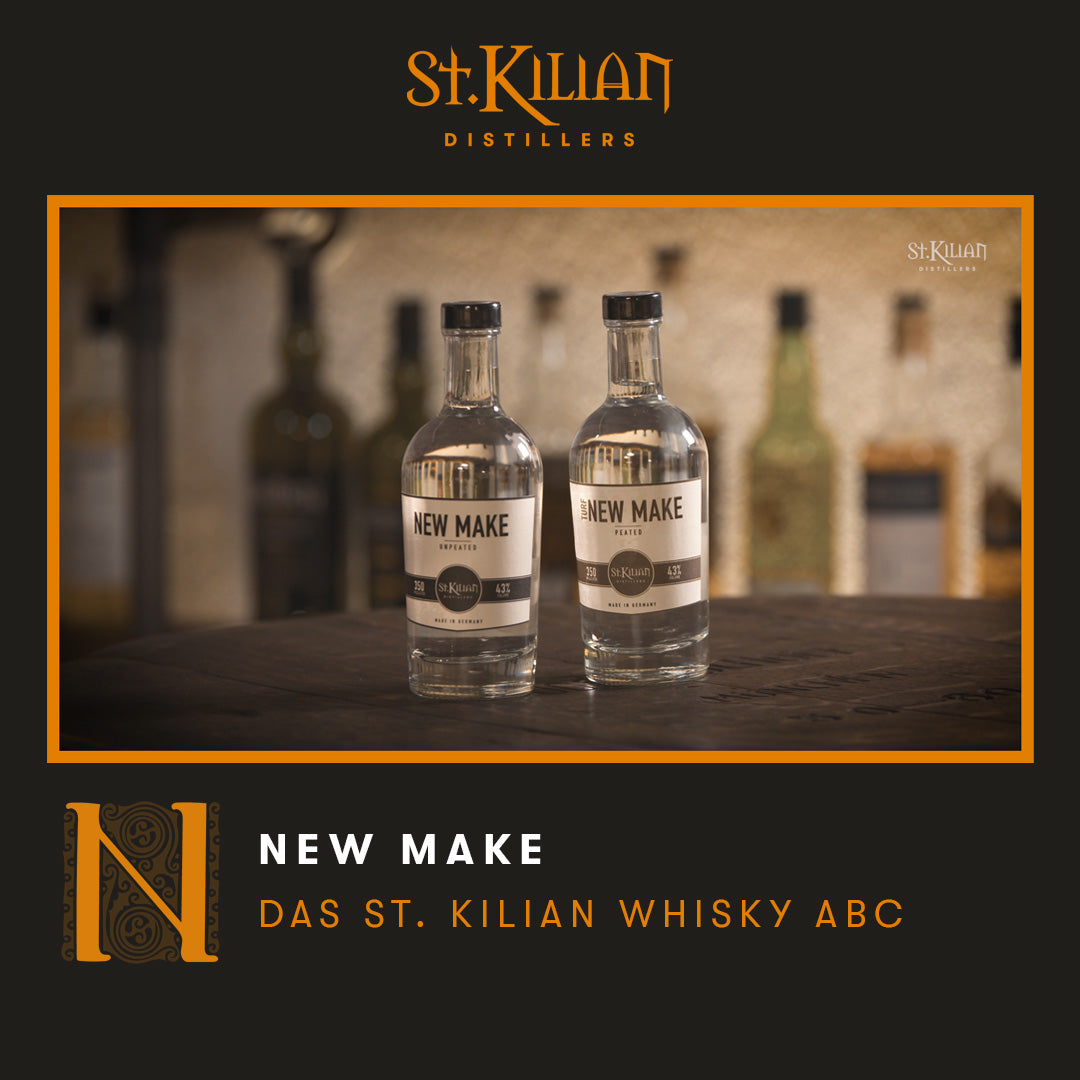

What is New Make?
New Make is the English term for the fresh distillate obtained after the second distillation in the spirit pot still. It refers to the middle cut, the heart of the distillation, where the foreshots and feints have been separated.
What other names are there for New Make?
In Scotland and most European countries, distilleries also use the terms "New Spirit" or "New Make Spirit" in addition to New Make. In US distilleries, however, the terms "White Dog" or "White Lightning" are more commonly used for the distillate that comes directly from the still. The name derives from the clear "color" of the New Make. Furthermore, in the USA, as well as in Ireland, the term "Moonshine" is common. On the Emerald Isle, it is also known as "Poitín".
What is the alcohol content of New Make?
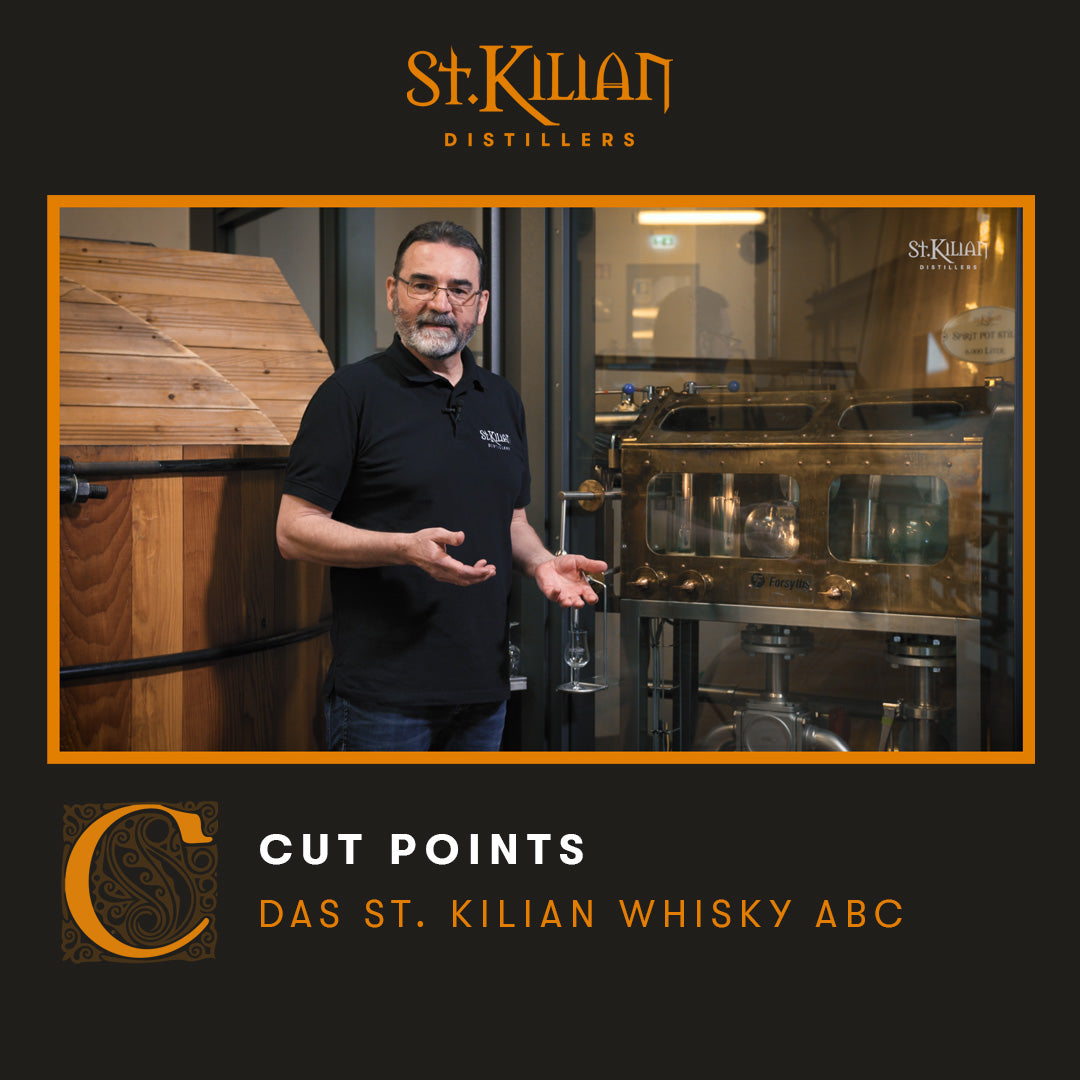
At St. Kilian, the middle cut is collected from an initial alcohol content of 72% by volume down to approximately 59% by volume. These are the so-called "cut points," which can vary depending on the composition of the barley malt in the mash, the "mashbill," and whether mild (unpeated) or peated malt is used. On average, the collected New Make then has an alcohol content of approximately 69.5% by volume.
Is the New Make diluted?
In most cases, at St. Kilian, the New Make is diluted with water to an alcohol content of 63.5% by volume before the wooden casks are filled and the distillate can mature into whisky.
Why this odd number?
The filling strength of 63.5% alcohol by volume (111 UK Proof), which is common in the whisky industry for casks, is now considered a uniform industry standard by many distilleries. This rather odd number comes from extensive research in Scotland, which showed that an alcohol content of 63.5% by volume achieves the best compromise between the quality and speed of maturation and economic aspects such as storage, handling, and cask management. In Scotland, this ensures a consistent maturation period and a more balanced taste of the matured whisky.
What is contained in New Make?
In addition to the main fractions of ethanol and water, New Make also contains various chemical compounds that – directly or indirectly – contribute to the aroma, taste, and mouthfeel of a matured whisky. These include, for example, various esters, higher alcohols (so-called fusel oils), and phenolic compounds.
What are esters?
Esters are chemical compounds formed by the reaction of an acid with an alcohol. Simplistically, esters can be thought of as a two-component adhesive. Component 1 (= acid) combines with Component 2 (= alcohol) and hardens as a mixture (= ester) while displacing water. Esters are largely responsible for the fruity smell and taste of a New Make. They are primarily formed during alcoholic fermentation, but also during distillation and years of maturation in wooden casks.
What are fusel oils?
Fusel oils generally refer to alcohols that have more than two carbon atoms (ethanol has two carbon atoms) in their structures. They owe their name to their oily consistency. Fusel oils are also known as fusel alcohols. This term is derived from the German word for bad schnapps, "Fusel." Fusel oils are formed from amino acids during fermentation. In small quantities of less than 300 mg/l, they lend a desirable character to whisky and contribute – either directly or in combination with acids as esters – to the aroma and taste of the matured spirit.
Do phenols also come from fermentation?
Yes. During alcoholic fermentation, yeast also forms phenolic compounds that are released into the beer-like liquid, the wash. However, clearly noticeable amounts of phenols, which are characterized by their smoky, medicinal, iodine-like, tarry, or brackish aromas, are formed during the kilning of the green malt over peat smoke.
What color is New Make?
New Make is a clear, colorless liquid and is visually indistinguishable from water. Only through maturation in wooden casks does New Make gain color. After a minimum storage period of three years in wooden casks and under compliance with other legally prescribed conditions, the matured New Make may then be called whisky in the EU.

Leave a comment
This site is protected by hCaptcha and the hCaptcha Privacy Policy and Terms of Service apply.