



What is filled into the casks?
The casks are filled with New Make Spirit. This is the English term for the fresh distillate obtained after the second distillation in the Spirit Pot Still. It is the middle cut, meaning the heart of the distillation, from which the foreshots and feints have been separated.
What is the alcohol content of New Make Spirit when filling the casks?
In most cases, the New Make Spirit for cask filling at St. Kilian has an alcohol content of 63.5% by volume. However, lower and higher alcohol contents are also common.
How is cask filling carried out at St. Kilian?
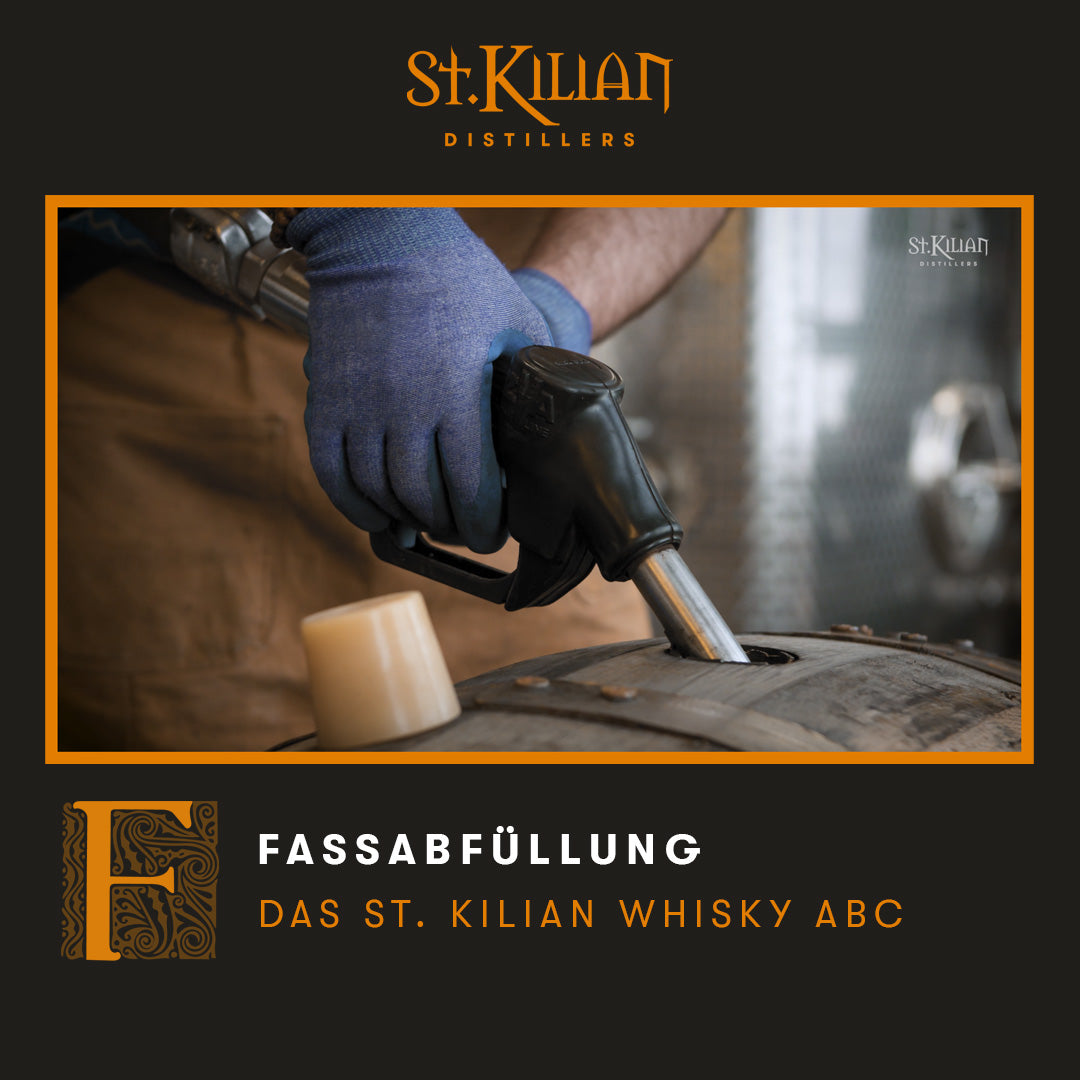
First, the cask to be filled is subjected to an odor test via the bung hole to check whether the aroma inside the cask has any off-notes. If the aroma is fine, a steel frame designed specifically for the casks is placed on a calibrated scale, and the weight display is set to zero with the tare button. Then the empty cask is placed on the frame, and its displayed tare weight is recorded in writing. The display on the calibrated scale is again set to zero using the tare button. The cask is filled with New Make Spirit from the storage tank ("Spirit Receiver") via a hose with a tap – similar to a gas station. After this process is completed, the weight of the filled cask is read and also noted.
What happens if the cask has an off-odor?
If an off-odor is detected inside the cask during the aroma check, e.g., a musty smell of mold, then this cask will naturally not be filled with valuable St. Kilian New Make Spirit but will be sorted out.
Must cask filling take place under customs supervision?
Yes. In the early days of St. Kilian, filling the casks was only permitted under the supervision of a customs officer. Up to three customs officers were present at St. Kilian every Wednesday, all day long, week after week, to legally verify the cask filling. With the increasing number of casks being filled weekly at St. Kilian, it quickly became clear that a pragmatic solution without the constant presence of customs officers was desirable for both sides. As a result, we are now allowed to fill casks as needed and required, without customs supervision. For this purpose, St. Kilian has appointed its own employees as tax assistants, who, so to speak, act as an extended arm of customs, accompanying and documenting the cask filling. This way, costs for customs or the taxpayer can be saved.
What is the task of the tax assistant?
The tax assistant also records all weight data displayed by the calibrated scale in writing, electronically with the help of a laptop. After the cask filling is completed, the handwritten and electronically recorded data are reconciled. If there is a match, this data is transferred to the digital cask ledger and thus legally recorded for customs purposes. The four-eyes principle applies to cask filling. This ensures the accuracy of the collected cask filling data from the perspective of customs.
What data is collected during cask filling?
The empty weight of the cask, the full weight of the cask after filling, and the alcohol content of the New Make Spirit are recorded in writing, with the alcohol content being determined using an officially calibrated hydrometer. Thus, during cask filling, not the volume, but the weight of the New Make Spirit is determined.
Why is the weight determined and not the volume?
Determining the amount of New Make Spirit after cask filling by mass has the great advantage that one does not also have to determine the temperature of the spirit. This would be the case if one were to determine the volume of the filling. This is because volume, unlike mass, is temperature-dependent. Therefore, determining the mass simplifies cask filling.
How can one infer liters of pure alcohol from the filling weight?
Using an official alcohol table, Table 2 can be used to read the liters of pure alcohol per 1000 kg of New Make Spirit from the mass of the New Make Spirit and the alcohol content (e.g., 63.5% by volume). Based on this data, the filled liters of pure alcohol, which are relevant for customs, are then calculated.



Leave a comment
This site is protected by hCaptcha and the hCaptcha Privacy Policy and Terms of Service apply.