


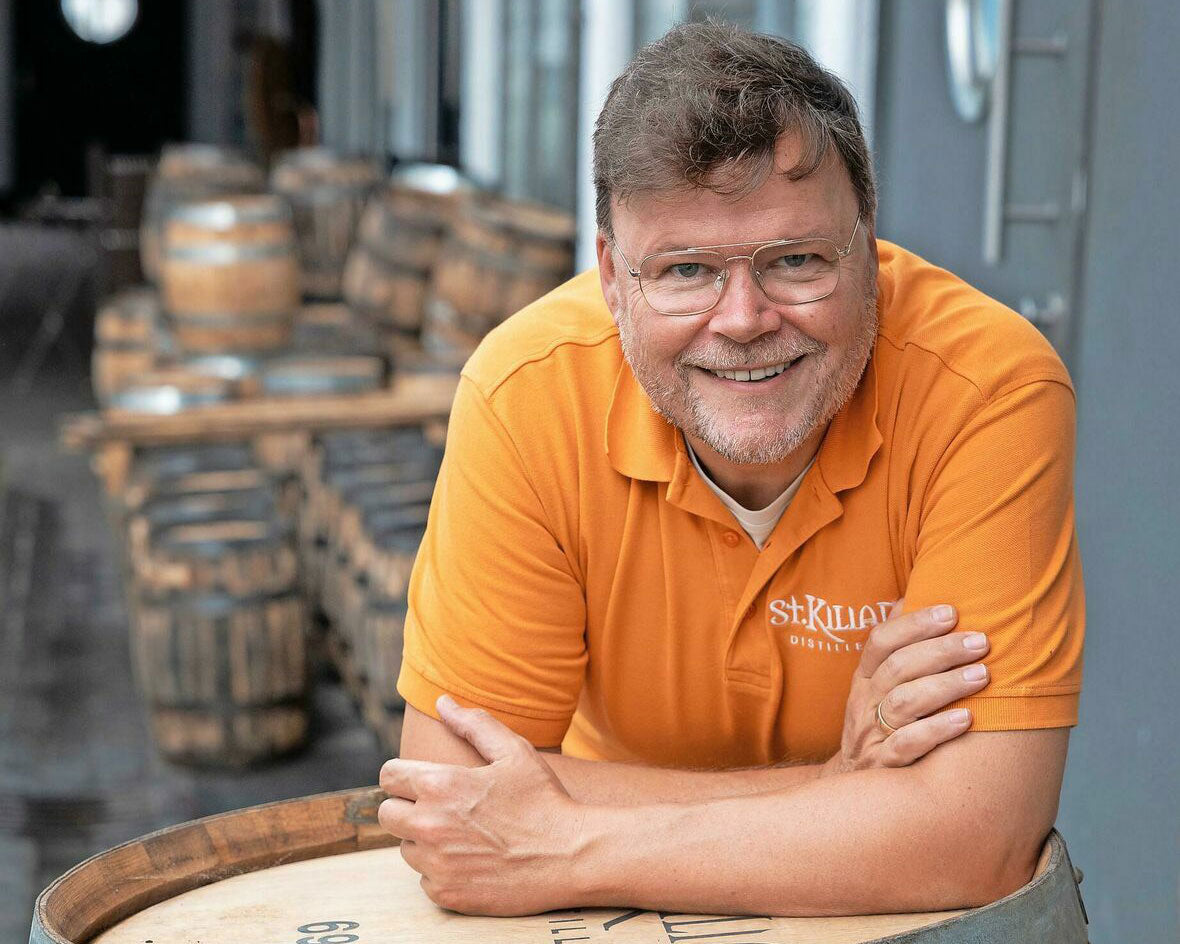

Andreas Thümmler founded the St. Kilian whisky distillery a decade ago in Rüdenau am Untermain. In an interview, he talks about money and patience, his particularly successful Bud Spencer line, and the potential for distilleries in Germany.
By Peter Badenhop, Frankfurter Allgemeine Zeitung
Rüdenau, December 2024
Mr. Thümmler, before you founded the St. Kilian distillery in 2012, you were an investment banker in London and Frankfurt. How did you come up with the idea of entering the whisky business?
Whisky had long been my great passion, and during my time in London, I repeatedly traveled to Scotland, visited distilleries, and started collecting whisky. In the end, I visited about 150 distilleries.
So you're a whisky freak?
Yes, you could say that. I once planned to visit all the whisky distilleries in the world – but that's obviously not possible given the abundance of distilleries that exist now. But I've been around quite a bit and have visited almost everywhere whisky is distilled. Except for Tasmania, but I'll get there too.
And how did you become a distillery owner yourself?
Initially, it was intended as an investment. I was looking for something that was crisis-proof and inflation-proof – and, of course, fun. The first idea was to buy whisky barrels. Many distilleries now offer that, and we do at St. Kilian too. But I didn't just want one or two barrels, but a few thousand or tens of thousands – but nobody does that. And then my friend David Hynes, one of the most renowned whisky experts and Master Distillers in Ireland, said: If you want that many
barrels, you'll have to build your own distillery. Well, and because I had no idea how something like that works, I persuaded him to do it with me.
That was in 2012?
Yes, that's when we started.
And why in Rüdenau of all places?
I'm from Rüdenau. And the starting point was the old textile factory here in town. It had been empty for a few years and was perfectly suited for our plans. And just look around: here between the Spessart and Odenwald, it's just like Scotland: rural, secluded, authentic. Our fans love that.
How did you finance the project?
As an investment banker, I earned a lot of money and reinvested some of it here.
How much do you need to build a distillery like St. Kilian from scratch?
About 15 million Euros as an initial investment – and a lot of patience. It took four years for our distillery with state-of-the-art technology to be completed; we started production in 2016. And we didn't bottle the first whisky until 2019. Well, and then came Corona.
What were the consequences for you?
Well, in the months before, we had an enormous number of visitors – and then suddenly everything stopped. We had to come up with something, and those were our online tastings. That was a great success, and we still do them regularly. With about 1000 participants each, they are the largest whisky online tastings worldwide.
Did that help you survive the pandemic?
Our second idea played an even bigger role: We brought our whiskies into supermarkets, which were open. But for that, we needed a brand that would also sell in retail and that you wouldn't have to explain much to anyone. That's how we came up with our Bud Spencer and Terence Hill editions. These are different blends of single malts with Irish whiskey – and they worked wonderfully.
What kind of whisky did you originally want to make when you founded St. Kilian? What style should your whiskies have?
My role model was, of course, Scotland. I wanted exclusively peated and ultra-peated whiskies, like those from Ardbeg and Lagavulin. And matured for at least 16 years. And 50,000 barrels of them. That was my initial plan. But that basically fell through. We currently have 12,000 barrels, and we
don't just make peated whiskies.
How would you describe your two standard whiskies that you always have in your range: the St. Kilian Classic and the St. Kilian Peated?
They are absolutely competitive with the top brands in Scotland. Our whiskies play in the Champions League. Both are very complex, at 46 percent alcohol a bit stronger than the mainstream. The Classic is mild and fruity like the whiskies from Speyside, while the Peated is a real peat bomb.
Is there a St. Kilian house character, as there is with so many Scottish distilleries?
Yes, you can already notice it in our New Make, i.e., the freshly distilled, unaged whisky: It already has these typical, tropical-fruity notes, like banana aromas, but also pear and apple.
Has the whisky boom of the past 40 years reached its peak?
From the perspective of the Scottish whisky industry, definitely. In the last ten years, enormous capacities have been built there, for example, to meet Asian demand. Some of the traditional markets may be slowly saturated, but new ones are emerging. In addition, the Scots are no longer the only ones who can distill and age really good whisky. The so-called New World Whiskies are putting pressure on the Scots. We, with St. Kilian, are among these new
distilleries – and when our "Bud Spencer The Legend" hits the supermarket shelf, there might be one less Scot there in the future.
When you founded St. Kilian, did you have no concerns about entering such a crowded market?
At the beginning, I didn't even want to enter the market. I actually only wanted my own 16-year-old peated whisky and eventually sell it.
But now you are on the market and successful.
Yes, we are growing every year. There is still great potential in Germany. There are only a few truly serious German distilleries. Of course, there are many schnapps distillers who make a few barrels of whisky. But so far, there are very, very few relevant whisky players in Germany.
Is your most important market Germany?
Yes, by far. We also sell a bit to Austria and Switzerland. But actually, we haven't internationalized yet; we are still too busy with our home market. We first want to establish the "Whisky made in Germany" label for German fans.


Leave a comment
This site is protected by hCaptcha and the hCaptcha Privacy Policy and Terms of Service apply.