


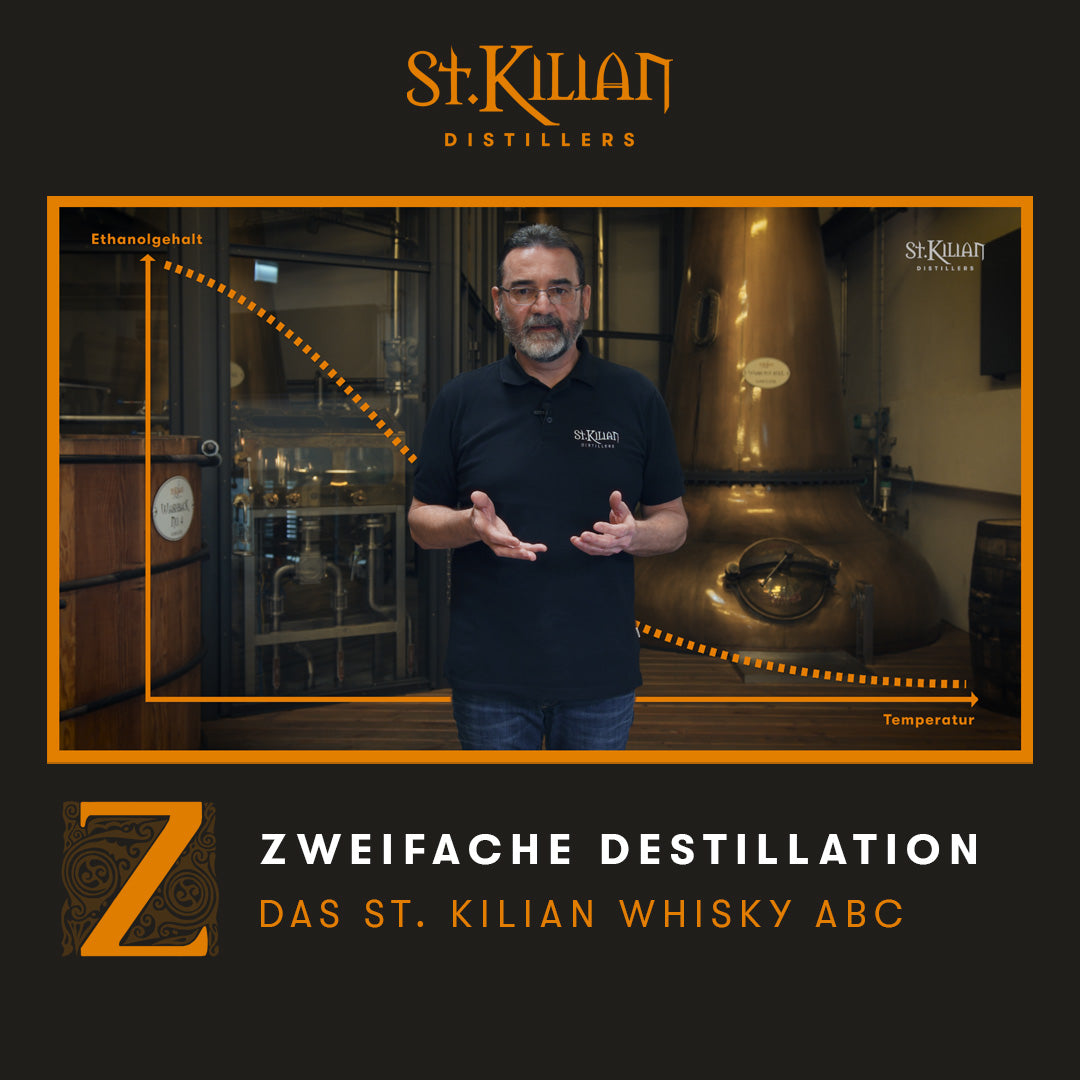

What is behind the term "distillation"?
Distillation is a physical process for separating liquids that have different boiling points. The principle is based on the fact that at a given temperature, the liquid with the lower boiling point (e.g., ethanol at 78.3°C) vaporizes first, while the liquid with the higher boiling point (e.g., water at 100°C) remains behind.
How often does distillation need to be carried out?
In the production of malt whisky, the beer-like, slightly alcoholic liquid from fermentation (= "wash") is distilled in copper pot stills. At St. Kilian, distillation is carried out discontinuously, i.e., using the so-called batch process. This involves at least two distillations. Some Scottish distilleries (e.g., Auchentoshan) even carry out this process three times.
Why is it distilled twice?
The reason for this lies in the laws of thermodynamics. The simple reason is that water and ethanol do not form an ideal mixture, as it is a non-ideal liquid mixture. This means that the mixture behaves differently from the individual pure substances (in our case, water and ethanol; the small amounts of aromatic substances are not considered) alone. This also affects the distillation behavior of the mixture, as the vapor-liquid equilibria of water and ethanol also show non-ideal behavior.
How does this non-ideal mixing behavior affect practice?
When the wash, with an approximate alcohol content of 7-8% by volume (vol.-%) ethanol, is heated, this mixture boils at about 90°C. Since ethanol is more volatile than water and boils at about 20°C lower at 78.3°C, it concentrates in the vapor phase. So, while the mixture in the liquid phase has an ethanol content of 7-8 vol.-%, this in the vapor phase is already about 45 vol.-%.
How does the ethanol content change during the first distillation?
Due to its volatility, ethanol accumulates in the vapor phase. This distillation vapor is condensed in the condenser and thus removed from the system in the still. This means that the amount of ethanol in the initial solution decreases during distillation, as more ethanol evaporates than water. Consequently, the liquid mixture in the still has an increasingly lower proportion of ethanol, boils at an increasingly higher temperature, and the amount of ethanol in the vapor becomes less and less. At the end of the first distillation, a total distillate (= "low wines") with an average of about 20-25 vol.-% ethanol is obtained.
Why is a second distillation necessary?
According to the EU Spirits Regulation, a whisky must have a minimum alcohol content of 40% by volume. Since we are still far from that with 20-25% by volume after the first distillation, a second distillation is required. The still for the second distillation is called a spirit still.
What happens before the second distillation?
The low wines obtained after the first distillation are combined with the separately collected foreshots and feints from the preceding second distillation, which still contain ethanol. This increases the ethanol content from an initial 20-25 vol.-% to approximately 25-28 vol.-%.
How does the second distillation proceed?
The mixture of low wines, foreshots, and feints with an ethanol content of approximately 25-28 vol.-% is now heated in the spirit still. It boils at a temperature of about 86°C and results in an enrichment of ethanol in the vapor phase of initially about 75-80 vol.-%. First, the highly alcoholic and sometimes toxic foreshots appear in the distillate, which are separated from the desired middle cut, the heart. The alcoholic middle cut, enriched with desired aromas, is collected until an alcohol content of about 60 vol.-% is reached, before the subsequent low-alcohol and undrinkable feints are collected separately and combined with the foreshots.
What is the conclusion of discontinuous distillation in pot stills?
The highest ethanol content in the distillate, which is still 7-8 vol.-% in the wash, is a maximum of 45 vol.-% after the first distillation in the pot still, and only at the beginning. As distillation progresses, this continuously decreases until a total of about 20-25 vol.-% ethanol is present in the distillate. For this reason, a second distillation process is necessary to achieve the required higher percentages by volume of ethanol and, on the other hand, to be able to separate the good, desired substances from the bad, undesired substances in the distillate.

Leave a comment
This site is protected by hCaptcha and the hCaptcha Privacy Policy and Terms of Service apply.