



How important is yeast for whisky production?
Yeast performs an extremely important job in whisky production. As it metabolizes various sugars and amino acids in the wort, it gains energy to grow and divide. In doing so, each yeast cell excretes various substances, such as ethanol (potable alcohol), carbon dioxide (CO2), and an enormous variety of different aroma and flavor compounds (e.g., fruity esters), some of which we later find in the matured whisky.
What is yeast?
Yeast belongs to the class of ascomycetes, which represent one of the major divisions in the kingdom of fungi. Yeasts are single-celled organisms, meaning they consist of only one cell. The most commonly used yeast for the fermentation of beer, wine, and whisky is Saccharomyces cerevisiae.
What does Saccharomyces cerevisiae mean?
The Latin names of microbes are chosen to provide insight into the function of the organisms. The yeast name is derived from "Saccaro" (meaning sugar), "myces" (meaning fungus), and "cerevisiae" (meaning beer). Combined, it translates to "sugar fungus of beer."
Which yeast strain is used?
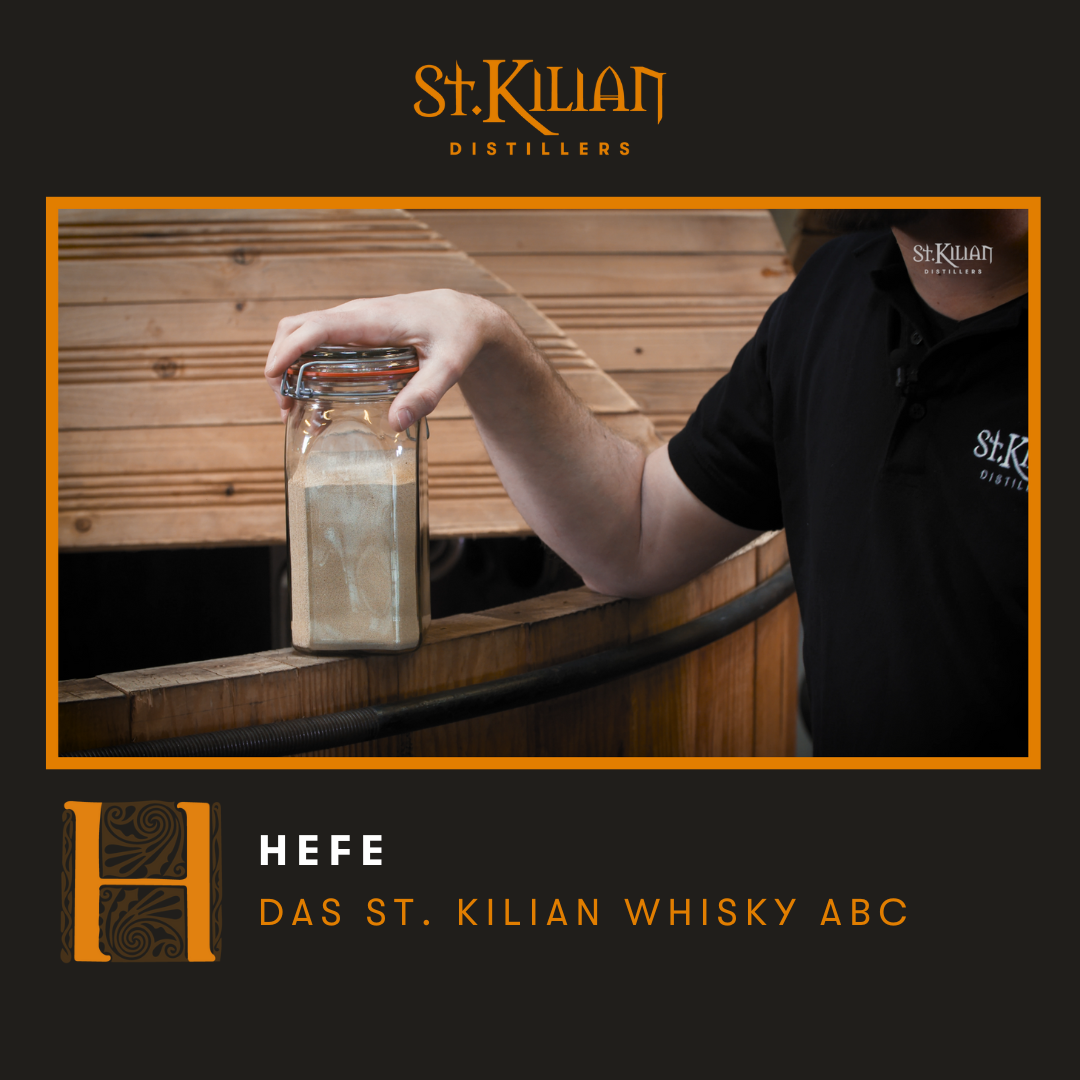
At St. Kilian Distillers, we rely on the traditional whisky yeast strain M1, which is also used in many distilleries in Scotland. We use this as dry yeast. This top-fermenting dry yeast is supplied to us in Rüdenau as free-flowing granules packed under a protective atmosphere in 10 kg bags. In addition to dry yeast, there are other variants – pressed yeast (in compressed form) and cream yeast (liquid suspension).
What are the advantages of dry yeast?
Dry yeast has the decisive advantage that it is very stable at room temperature and therefore does not require cold storage. With additional cooling (4-8°C), however, it can even be stored for up to two years. Furthermore, it delivers consistent quality and can be conveniently stocked in handy bags. The liquid cream yeast often used in Scotland, which is delivered fresh in tanks by truck, is hardly used in German distilleries due to a lack of infrastructure.
How quickly does yeast produce ethanol?
Yeast can convert an enormous amount of wort into alcohol in a very short time. For us, alcoholic fermentation in the wooden washbacks takes about 65 hours. During this time, the yeast has converted 10,800 liters of sugary wort into a beer, known as wash, with an ethanol content of 8% by volume. Since many beer yeasts do not have such alcohol tolerance, we rely on whisky yeast M1 for fermentation.
Are other yeast strains also used?
At St. Kilian Distillers, we are known for our great willingness to experiment. In the initial phase of our production, we tried a number of different yeasts – such as vodka, bourbon, or grain yeast – but only the whisky yeast M1 convinced us regarding the desired aroma and fruitiness. This is no great surprise, as M1 is traditionally the most widely used yeast strain in Scottish distilleries. Therefore, we concentrate our experimental spirit much more on different malt mixtures and various cask sizes and types, and stick to the M1 yeast strain.
How important is yeast?
Yeast has a very strong influence on the character of our New Make Spirit and later whisky. This is because the origin of many of the aromatic substances that we find in the matured whisky after years of cask aging comes from the process step of alcoholic fermentation. The use of whisky yeast M1 in conjunction with an optimal fermentation temperature of 31.5°C to 32.0°C provides the wonderful fruity aromas of apple and pear in our New Make and represents the distillery character of St. Kilian. This recognition value in our spirits and whiskies is enormously important to us and therefore very dear to our hearts.


Leave a comment
This site is protected by hCaptcha and the hCaptcha Privacy Policy and Terms of Service apply.