


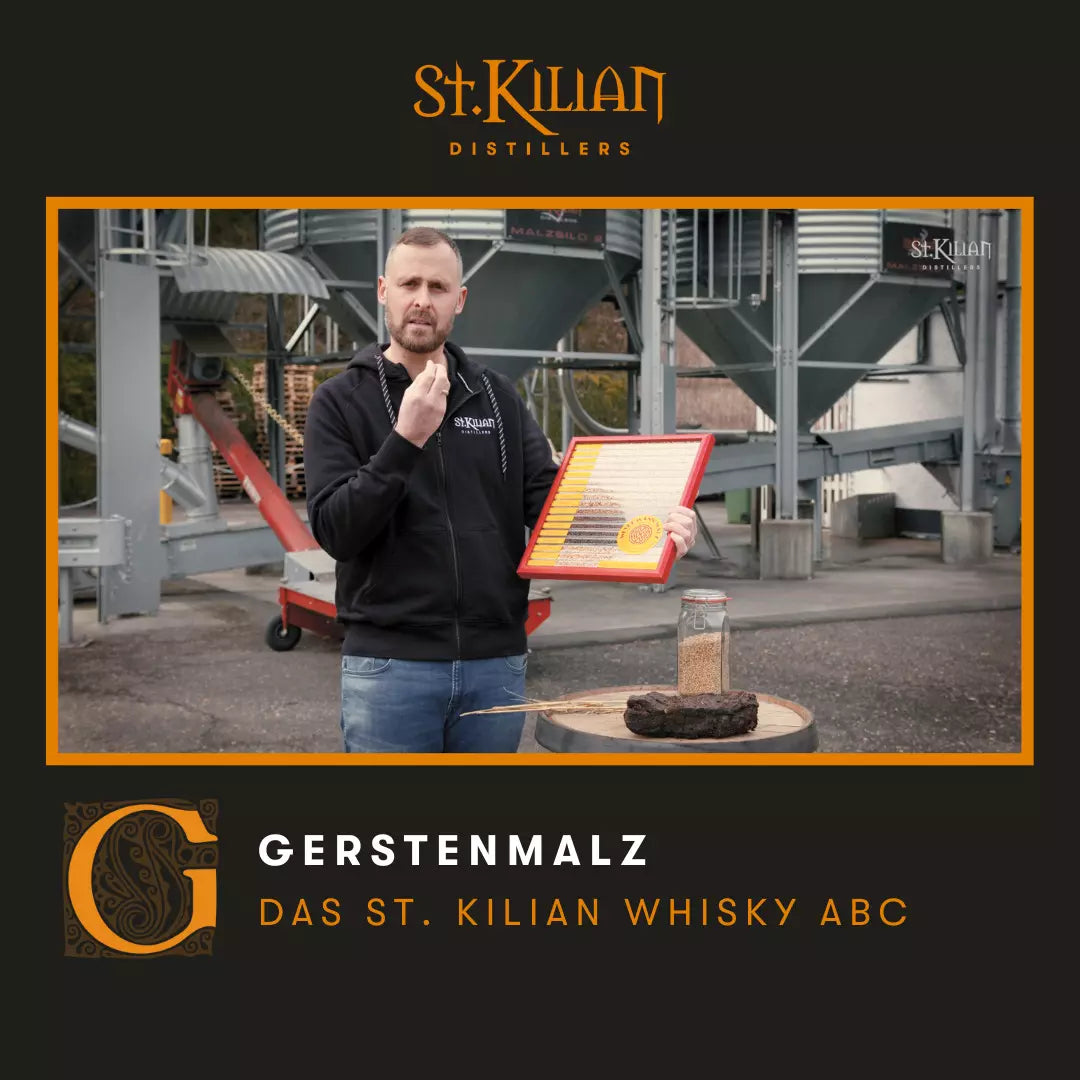

What is barley malt?
Barley malt is produced by malting barley. This production step describes a controlled germination process in which enzymes are formed or activated in the barley grain, which break down the stored reserve substances – such as starch and proteins – into smaller fragments. This changes both the chemical composition and the consistency and taste of the barley grains. By far the most commonly malted grain is barley. In addition, other grains such as corn, wheat, oats and rye can also be malted.
What type of barley is used?
One of the most important raw materials for whisky production is barley malt. To produce a single malt whisky, as is the case at St. Kilian Distillers, the exclusive use of malted barley is even prescribed. The barley used in the whisky industry is usually two-row, nodding spring barley. This is a barley variety that is sown in spring and harvested after almost 100 days. Only one large, full grain develops per spikelet. The long ear of nodding barley, also known as land barley, is narrow and bends during ripening.
How is barley malt produced?
Malting barley is a complex process, usually carried out in large-scale malt houses – such as the Malzfabrik Weyermann®, a medium-sized family business based in Bamberg. The barley grains are soaked in water and can then germinate under controlled conditions. Finally, the water is removed from the resulting green malt by drying. During germination, natural enzymes are formed in the barley grain or converted from their inactive to their active form. These enzymes act as catalysts to accelerate certain biochemical reactions and convert, among other things, the starch contained in the barley grain into simpler sugar components and proteins into smaller proteins. Due to this natural, enzymatic breakdown, the malted grain – compared to the hard and tasteless barley grain – is significantly softer in consistency and sweeter in taste.
Which peated malts are used?
Various types of barley malt are used for whisky production. In the whisky industry, a distinction is generally made between smoked and unsmoked malt. For our smoked malt at St. Kilian Distillers, we use beechwood smoked malt from Germany, where the barley malt has been kilned over a beechwood fire. Another very important malt for us is peat-smoked malt, which we source directly from Glenesk Maltings in Scotland. This barley malt is smoked with peat smoke, which is produced by burning dried peat. This peat smoke contains the typical, highly aromatic phenols that adhere to the malt grain and can later be found in the matured whisky – usually in low concentrations.
What influence does kilning have on the malt?
Smoked malts only make up a small portion at St. Kilian. The majority of malt processed by us is unsmoked malt, with Pilsner malt forming the main part. This is also the standard malt in German breweries for producing Pilsner or export beer. By varying the heat exposure during kilning, the malt can be altered. The longer the kilning and the higher the temperature, the darker the malt becomes. This is because chemical reactions between amino acids and sugars in the grain, known as the Maillard reaction, form roasted aromas and colorants that darken the malt. Roasted malts, due to additional caramelization of sugars, become very dark to black, almost resembling small, roasted coffee beans.
What needs to be considered when using roasted malts?
Roasted malts bring aromas of chocolate and bread crust. However, it should be noted that due to the strong roasting or caramelization of the malts, sugar is consumed, which will be missing later during alcoholic fermentation. This lack of sugar is reflected in a low alcohol yield. The brewer must take this into account when using roasted malts in their malt mixture and increase the amount of malt used accordingly to achieve a consistent alcohol yield. Furthermore, it must be noted that due to the high temperatures during kilning, the temperature-sensitive enzymes formed in the roasted malt are weakened or destroyed and are therefore no longer available for starch degradation. Therefore, for the production of beer or whisky, roasted malts are only added to the respective malt mixtures in a small percentage.
Which malts are used at St. Kilian?
At St. Kilian Distillers, we use both smoked and unsmoked malt.
Smoked malt:
- Beechwood smoked malt (from Germany)
- Peat smoked malt (from Scotland)
Unsmoked malt:
- Pilsner malt
- Heimat Malt (Brewing barley from Reichartshausen by farmer Andreas Henn)
- Barke Malt® (two-row historic spring brewing barley)
- Munich Malt Type 2
- Vienna Malt
- Caramünch®
- CaraAroma®
What flavors are obtained with Munich malt?
For example, if the slightly darker, light brown Munich malt, in contrast to the light Pilsner malt, is used for whisky production, then after alcoholic fermentation in beer and later – after distillation and maturation in wooden casks – in whisky, fewer fruity notes are found, but more malt-accentuated aromas of caramel and bread. These come from the slightly more heavily kilned Munich malt.


Leave a comment
This site is protected by hCaptcha and the hCaptcha Privacy Policy and Terms of Service apply.