


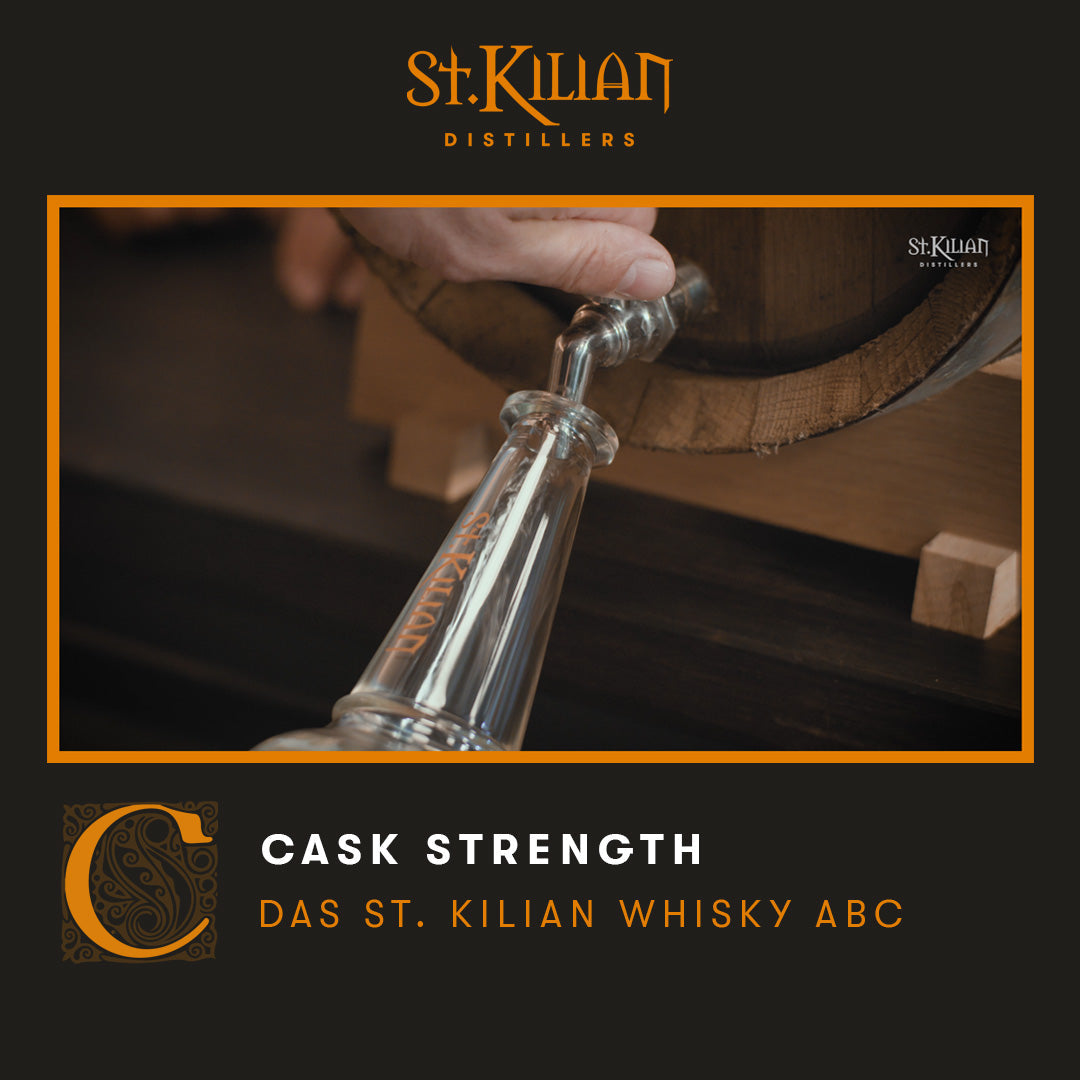

What does the term Cask Strength mean?
Cask Strength is an English term and literally means "barrel strength."
What is understood by cask strength?
If a whisky is bottled at Cask Strength, it means that the aged spirit has not been diluted with demineralized water after the cask has been emptied and before bottling. Cask strength is therefore the alcohol strength (alcohol content) with which the whisky goes from the cask into the bottle.
Does Cask Strength only refer to one cask?
No. A whisky bottled at cask strength can originate from one, two or more casks. The number does not matter. However, no water may be added before the whisky is bottled.
Must the term Cask Strength be stated on the label?
No. This information does not have to appear on the label of a whisky bottle. However, it makes sense for the manufacturer to let the consumer know that the content has the alcohol concentration it naturally achieved after years of maturation.
What is the alcohol content of a cask strength whisky?
This varies greatly. Most cask strength whiskies have a relatively high alcohol content, which can be anywhere between 55 and 65 percent by volume. However, there are also whiskies, especially those that have matured for a very long period of several decades in one or more casks, which already have a low alcohol content of between 40 and 45 percent by volume when undiluted.
Where does the variation in alcohol content of Cask Strength whiskies come from?
This depends on the Angels' Share, the portion of the angels. This is the part of the liquid content that escapes from the maturation cask over time through evaporation. Depending on the prevailing temperature, humidity and other conditions in the warehouse, relatively more alcohol than water can evaporate from such a cask during the maturation of the whisky. In this way, the alcohol content in the whisky decreases during cask maturation. However, there are also whiskies that gain in alcohol strength because relatively more water than alcohol evaporates during cask maturation. This is particularly the case in warm and dry areas.
What is the advantage for the consumer of buying a cask strength whisky?
An advantage for the consumer is that with a Cask Strength whisky in the glass, you can experiment with adding a few drops of water and thus sensorially perceive its change at decreasing alcohol levels. This is because by adding water, aromas are released differently, masked, or pushed into the background, so that the whisky constantly changes. This can be very exciting. In addition, with a whisky bottled at cask strength – compared to a bottling diluted to 40 percent by volume – the connoisseur simply gets more "whisky for their money," and that is certainly a bonus not to be neglected.
What is the advantage for the distillery of bottling a whisky at cask strength?
For a distillery, it makes perfect sense to have at least one Cask Strength bottling in its portfolio, in addition to whisky at drinking strength (usually 40%, 43% or 46%). A cask strength whisky offers the pure taste: unadulterated, undiluted and non-chill filtered. With single cask bottlings, this can be extremely exciting, because each cask reflects its individual character in the whisky and can differ significantly from the contents of a sister cask lying next to it.
Which whiskies are bottled at Cask Strength at St. Kilian?
Our Handfilled Single Malt Whiskies, which are only available at the distillery shop in Rüdenau, are Cask Strength whiskies. Many other single cask or special bottlings are also bottled undiluted. Our Signature Editions, however, are usually Single Malt Whiskies that are bottled at drinking strength (at least 46%) or at a higher drinking strength. Because sometimes even a few percentage points of reduction in cask strength with water can be enough to achieve the desired flavour profile for the whisky that we, and hopefully our fans, enjoy.

Leave a comment
This site is protected by hCaptcha and the hCaptcha Privacy Policy and Terms of Service apply.