


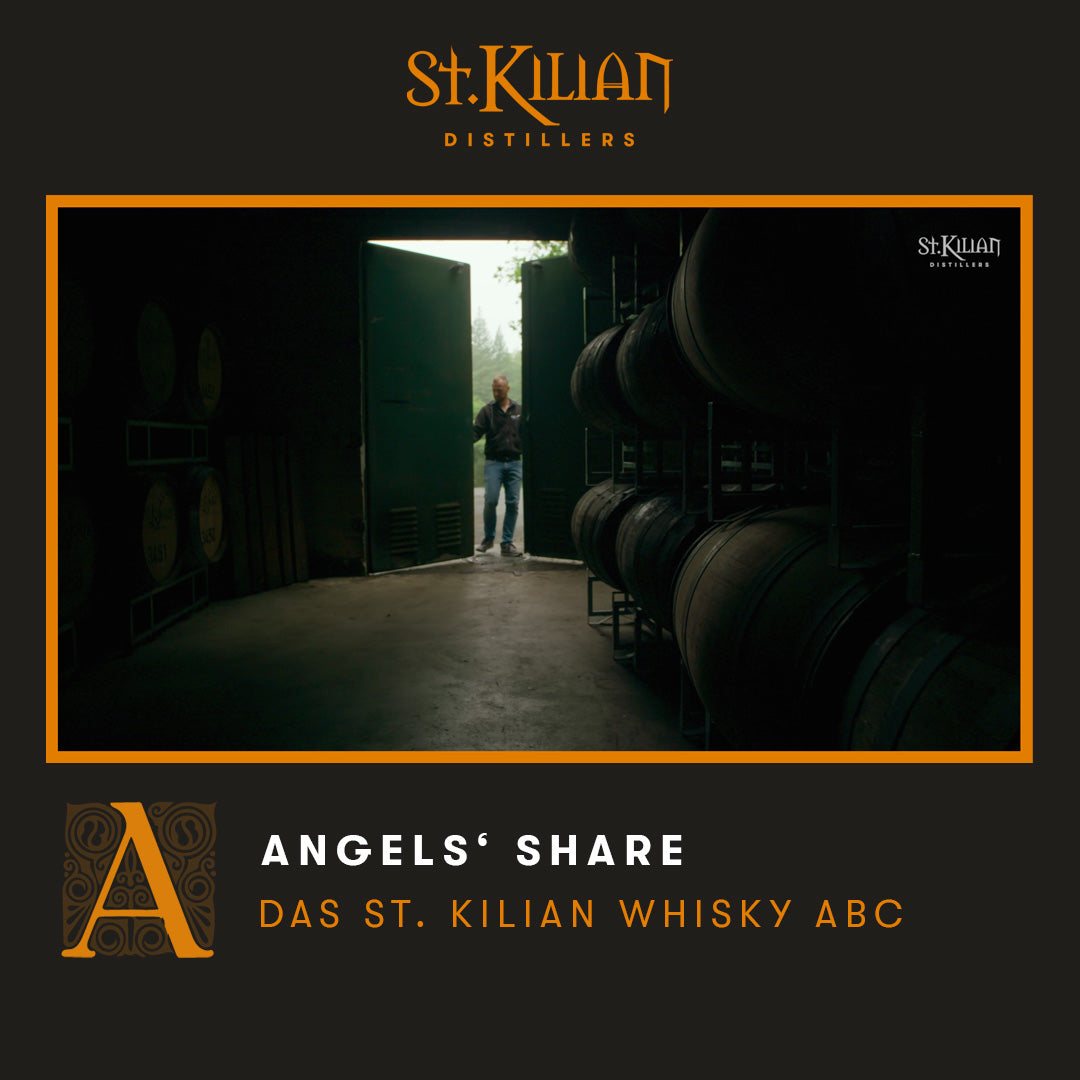

What does the term Angels' Share mean?
The term "Angels' Share" comes from English and literally means "share of the angels".
What is understood by Angels' Share?
Angels' Share refers to the loss of liquid volume in a whisky cask due to evaporation.
Can you smell the Angels' Share?
Oh yes! The unmistakable, aromatic, and slightly alcoholic smell that you immediately notice upon entering a warehouse is due to precisely that volatile component that has escaped from the maturing casks and is destined for the angels.
How can liquid escape from an intact wooden cask at all?
Through the microscopically small pores of the wood and the tiny spaces between the individual staves, liquid can escape from the inside of a cask to the outside through evaporation. This happens regardless of how carefully a cooper has built the cask and how tightly the staves are arranged next to each other.
How can liquid evaporate in the cask?
As soon as a cask is filled with fresh distillate, i.e., the new make, the evaporation process begins. Since casks are rarely filled completely, a small air reservoir usually remains between the liquid surface and the top of the lying or standing cask, which is known as the headspace. The cask staves provide an additional increase in headspace, as they can absorb fresh distillate like a sponge. In contrast to already seasoned casks, the staves of fresh, unseasoned casks absorb up to two percent of the total spirit volume after the cask is filled. During evaporation, ethanol and water molecules with sufficient energy leave the maturing liquid and enter the headspace as vapor. These molecules then push their way out of the cask through the tiny wood pores and gaps between the staves.
Which substances evaporate from the cask?
During evaporation, primarily the main components of the new make, i.e., water and ethanol alcohol, leave the cask. But other chemical substances in the distillate, such as volatile fusel alcohols, aldehydes, esters, and sulfur compounds, can also evaporate in the cask and thus find their way out.
How large are the liquid losses due to the Angels' Share?
In Scotland, these liquid losses occur at an annual rate of about two percent of the volume on average. This means that after eight years of maturation, about 15 percent of the whisky is lost through evaporation alone. After 20 years, the volume in the cask can even have decreased by a third or more. For a fully filled 250-liter cask, that would still be more than 80 liters lost to the Angels' Share. A considerable economic loss! Since the evaporation rate depends on, among other things, the temperature, the annual evaporation in hotter climates, such as India or Taiwan, even reaches a double-digit percentage and is accompanied by even higher volume losses.
How high is the Angels' Share at St. Kilian?
Here in the Odenwald, it's certainly a bit warmer than in Scotland. Therefore, the Angels' Share is also a bit higher. In the cooler warehouses of our Bunker City, the volume loss averages between three and four percent per year, and even slightly higher in the warmer warehouse at the distillery in Rüdenau. This corresponds to the magnitude allowed by customs. German customs allows a volume loss of up to four percent per cask per year, tax-free. Anything beyond that must be taxed by the distillery. This means that in this case, we would have to pay for something that is ultimately no longer present.
What escapes faster from the cask, water or ethanol?
Water and ethanol are the main components in New Make, which is usually filled into casks with an ethanol content of 63.5 percent. Both escape from the cask at different rates, as their evaporation rate depends on the ambient conditions of the casks in the warehouse, such as temperature and relative humidity. The physical reason for this is the tendency of similar systems to equalize. Thus, the amount of water in the distillate inside the wooden cask always tries to establish an equilibrium with the amount of water surrounding the cask, i.e., with the humidity in the warehouse. In high humidity in the warehouse, this atmosphere surrounding the cask is already saturated with water, so the proportion of water in the liquid that escapes from the cask through evaporation is lower than ethanol. Conversely, a less watery environment of the cask, i.e., drier air in the warehouse, causes a relatively stronger evaporation of water from the cask, in order to compensate for the larger humidity differences between the inside and outside of the cask.
Is the Angels' Share the same in small warehouses?
No. Even in a Dunnage Warehouse, where a maximum of three casks are stacked on top of each other, there are different evaporation rates. Since ethanol is heavier than air, the alcohol will tend to stay at the bottom of the warehouse. This means that relatively more water than ethanol will evaporate from the bottom cask in the row to equalize the humidity differences. The top cask, on the other hand, is less surrounded by ethanol. Thus, the ethanol-water ratio of the Angels' Share from this cask will be different from that of the bottom row of casks.
What is the consequence of the different evaporation rates of ethanol and water?
At high humidity and lower temperatures in the warehouse, relatively more ethanol evaporates from the cask than water, and the ethanol content decreases during the maturation of the whisky. This is the typical situation in Scotland, where the relative humidity is often 80 to 90 percent, especially in winter. In relatively hot and dry climates, such as in the American state of Kentucky, more water than ethanol is lost through the Angels' Share, leading to an increase in the ethanol content in the cask during the maturation of the whisky.
So, on what conditions does the Angels' Share depend?
The total amount and the relative rate at which the main components water and ethanol escape from the wooden cask through evaporation depend on the following parameters:
- Type of wood the cask is made from
- Cask size (the smaller the cask, the larger the Angels' Share)
- Cask type (fresh, once or multiple times seasoned cask)
- Quality of the cask or cooper's craftsmanship
- Type of maturation warehouse (Dunnage or Racked Warehouse)
- Temperature and humidity in the warehouse
- Alcohol content of the New Make (filling strength)
- Position of the cask in the respective warehouse
Does the Angels' Share also have positive effects?
Of course! Because if something escapes from the cask, something else can flow back in. And that is air. An exchange with air is extremely important for maturation. The oxygen contained in the air causes oxidation, which is a significant process in the maturation of whisky in the cask. Thus, ethanol alcohol and other alcohols, such as fusel oils, can be oxidized with oxygen to chemical compounds, such as aldehydes and acids. These aldehydes can further react with alcohols to form flavor-giving compounds. The acids, in turn, react with alcohols to form esters, which are noticeable by their extraordinarily fruity aromas in the matured whisky.
Can you also see the Angels' Share?
Indirectly, yes. There is a black, soot-like fungus that feeds on the evaporated ethanol alcohol. Its Latin name is Baudoinia compniacensis. This fungus grows on the walls of warehouses and can even spread to surrounding trees, shrubs, and buildings. Blackened warehouses already indicate from a distance that whisky casks are stored there. These discolored outer walls can be seen in the USA and Scotland, as well as here in Bunker City.

Leave a comment
This site is protected by hCaptcha and the hCaptcha Privacy Policy and Terms of Service apply.